Bertrand MOGNIAT DUCLOS
(Sedan 1903 - Clichy La Garenne 1987)
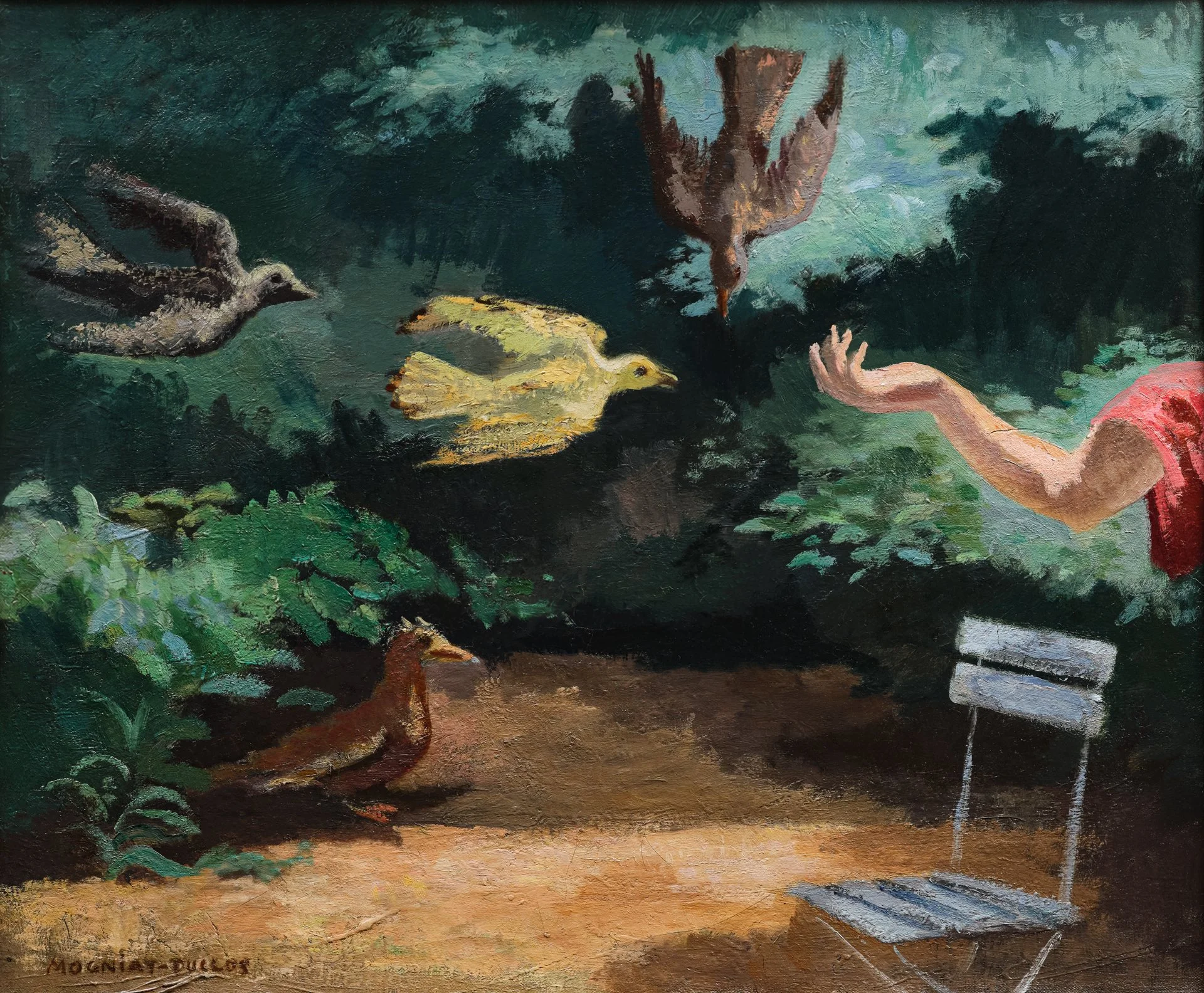
Les oiseaux
Huile sur toile
Signée en bas à gauche
54 x 65 cm
« L'œuvre de Mogniat-Duclos s'inscrit au point de rencontre de l’expressionnisme du début du siècle avec la nouvelle génération qui comprend entre autres La Patellière, Charles Dufresne et Marcel Gromaire »
René Huyghe de l'Académie Française
Installé dans le bouillonnant quartier de Montparnasse, Bertrand Mogniat Duclos, commence à exposer dès les années 1920. Il participe aux principaux salons parisiens, notamment des Tuileries, des Indépendants et d’Automne. Son œuvre est également présentée dans plusieurs galeries parisiennes, parmi lesquelles Primavera, Gerbo, Bernheim-Jeune, Allard et surtout la galerie Katia Granoff, où il expose régulièrement de 1944 à 1955. Après-guerre, il participe à plusieurs expositions en France et à l’étranger et obtient la reconnaissance institutionnelle en entrant dans les collections publiques, notamment au Musée Nationale d’Art Moderne de Paris.
Proche d’Amédée de La Patellière, le peintre fait le choix de la figuration. Dans ses compositions riche de symboles, l’homme est contemplatif. Et, parfois presque absent, mais attentif à un monde mystérieux, où les éléments s’animent dans une nature fantasmagorique.
« Mogniat-Duclos’s work lies at the intersection of early 20th-century Expressionism and the new generation, which included, amongst others, La Patellière, Charles Dufresne and Marcel Gromaire »
René Huyghe from Académie Française
Based in the bustling Montparnasse district, Bertrand Mogniat Duclos began exhibiting as early as the 1920s. He took part in the major Parisian art fairs, notably the Tuileries, the Indépendants and the Salon d’Automne. His work was also shown in several Parisian galleries, including Primavera, Gerbo, Bernheim-Jeune, Allard and, above all, the Katia Granoff Gallery, where he exhibited regularly from 1944 to 1955. After the war, he took part in several exhibitions in France and abroad and gained institutional recognition when his work was acquired by public collections, notably the Musée National d’Art Moderne in Paris.
Close to Amédée de La Patellière, the painter chose to work in a figurative style. In his compositions, rich in symbolism, the figure is contemplative. And, at times, almost absent, yet attentive to a mysterious world where the elements come to life in a phantasmagorical natural setting.