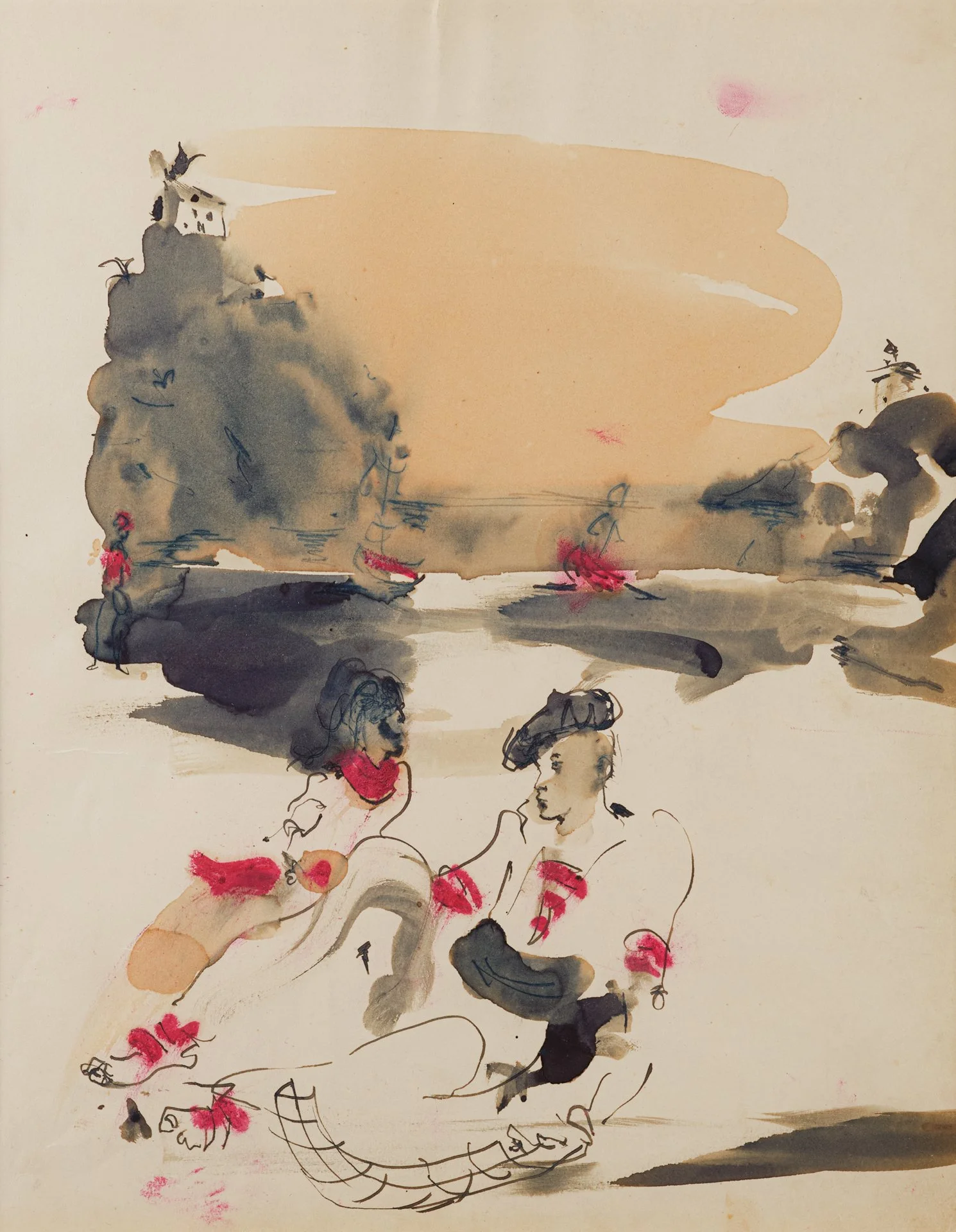
Christian BERARD
(Paris 1902 - Paris 1949)
Hommage au Pays Basque
Encre et aquarelle sur papier
Signée et titrée au dos
31 x 25 cm
Christian Bérard, surnommé « Bébé », appartient à cette génération d’artistes pour lesquels les frontières entre peinture, théâtre, mode et littérature n’ont jamais véritablement existé. Formé à l’Académie Ranson auprès de Maurice Denis et marqué par l’enseignement d’Édouard Vuillard, il se fait connaître dès sa première exposition à la galerie Pierre en 1925. La même année, sa rencontre avec Jean Cocteau est décisive : ce dernier l’introduit dans son cercle et l’oriente vers le théâtre, où Bérard va progressivement trouver l’un de ses principaux terrains d’expression. Il particpe également, à la fin des années 1920, au mouvement des néo-romantiques aux côtés notamment de Pavel Tchelitchew, des frères Berman et de Kristians Tonny. Parallèlement, ses relations avec Boris Kochno, figure majeure des Ballets russes, l’inscrivent dans l’univers de la danse et des spectacles.
À partir des années 1930, Christian Bérard devient ainsi l’un des artistes les plus convoités de la scène parisienne. Il imagine décors et costumes pour Jean Cocteau, Louis Jouvet et Roland Petit, travaille pour le cinéma et collabore avec Jean-Michel Frank dans le domaine de la décoration. Son amitié avec Christian Dior, rencontré dans les années 1920 par l’intermédiaire d’Henri Sauguet, constitue un autre lien majeur : Chrisitan Dior collectionne ses dessins et, en 1947, lui confie le décor de sa première boutique, avenue Montaigne. Si l’artiste décède prématurément en 1949, il connaitra également la reconnaissance institutionnelle, par différentes rétrospectives d’envergure.
Christian Bérard, nicknamed ‘Bébé’, belongs to that generation of artists for whom the boundaries between painting, theatre, fashion and literature never truly existed. Trained at the Académie Ranson under Maurice Denis and deeply influenced by the teachings of Édouard Vuillard, he made a name for himself from his very first exhibition at the Galerie Pierre in 1925. That same year, his meeting with Jean Cocteau proved decisive: Cocteau introduced him to his circle and steered him towards the theatre, where Bérard would gradually find one of his principal outlets for expression. In the late 1920s, he also took part in the Neo-Romantic movement alongside, notably, Pavel Tchelitchew, the Berman brothers and Kristians Tonny. At the same time, his relationship with Boris Kochno, a leading figure in the Ballets Russes, introduced him to the world of dance and the performing arts.
From the 1930s onwards, Christian Bérard thus became one of the most sought-after artists on the Parisian scene. He designed sets and costumes for Jean Cocteau, Louis Jouvet and Roland Petit, worked in film and collaborated with Jean-Michel Frank in the field of interior design. His friendship with Christian Dior, whom he met in the 1920s through Henri Sauguet, was another key connection: Christian Dior collected his drawings and, in 1947, commissioned him to design the interior of his first boutique on Avenue Montaigne. Although the artist died prematurely in 1949, he was also recognised by the art world through a number of major retrospectives.