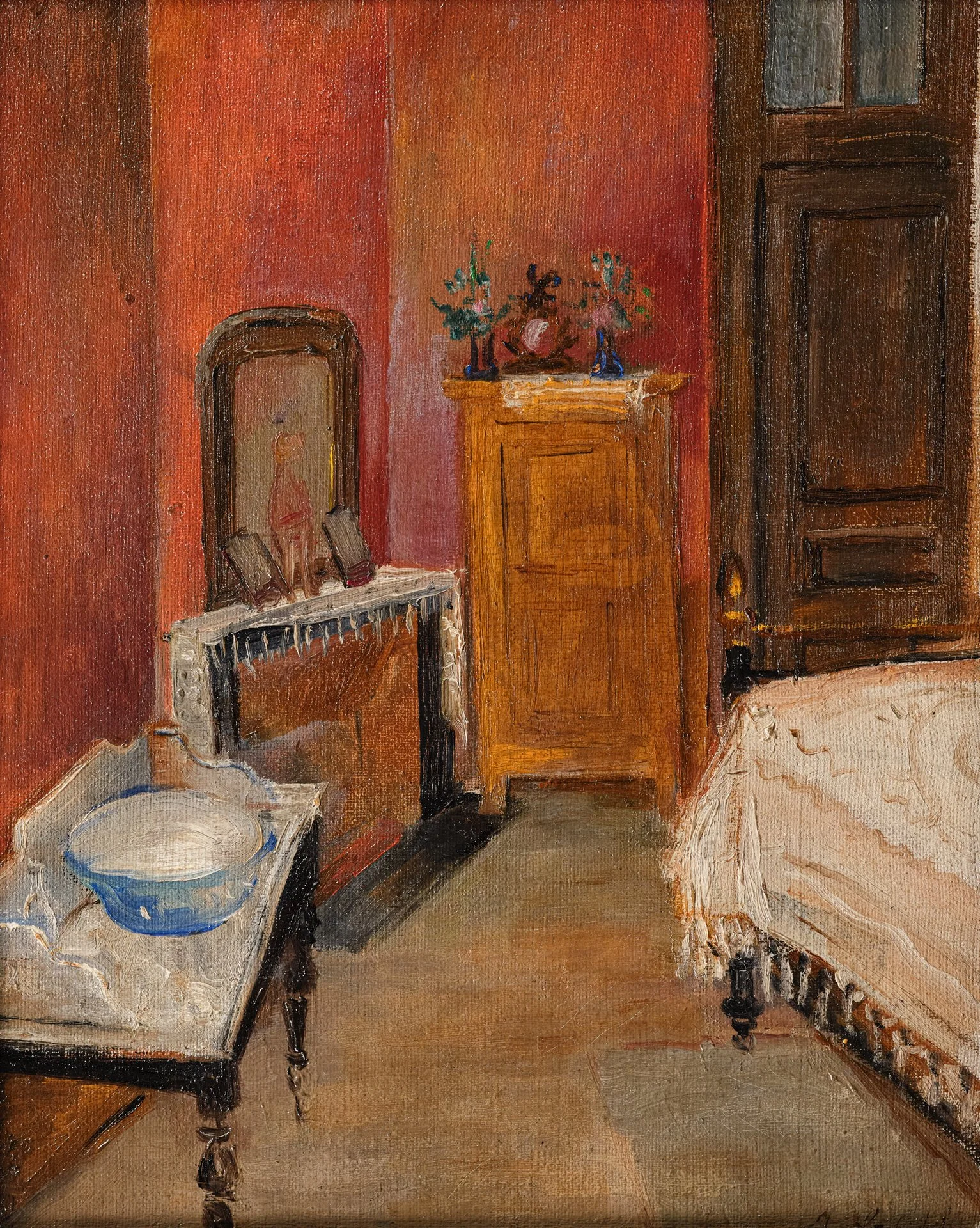
Ossip LUBITCH
(Grodno, Empire Russe 1896 - Paris 1990)
La chambre
Huile sur toile
Signé en bas à droite
41 x 33 cm
Issu d’une famille de forgerons, Ossip Lubitch passe son adolescence à Odessa, où il étudie pendant quatre ans à l’Académie des Beaux Arts. En 1919, il part pour Berlin avec un groupe d’artistes russes dont Pavel Tchelitchev, Jean Pougny et Lazare Meerson, avec lesquels il crée des décors de théâtre et de cinéma. Ossip Lubitch rêve de se consacrer entièrement à la peinture et envisage de partir pour Paris.
En 1923, un contrat pour la décoration d’un cabaret montmartrois lui donne l’occasion de rejoindre la capitale. Il étudie alors l’art des grands maîtres et comprend à travers l’oeuvre de Rembrandt, de Goya et de Degas l’importance du dessin. En 1925, le sculpteur Antoine Bourdelle l’encourage et l’introduit au Salon des Tuileries, puis d’Automne et des Indépendants. Exposant notamment chez Durant Ruel, et à la Galerie Zak, l’artiste est célébré pour ses visions introspectives.
En 1934, Ossip Lubitch publie un album intitulé Cirque, qui comprend un ensemble de dix eaux fortes aquatintes, préfacé par un poème de Georges Rouault. Pendant la guerre, l’artiste ne cesse de peindre dans son atelier, mais est arrêté et interné à Drancy. Il s’enfuit le 18 août 1944, au lendemain du dernier convoi pour Auschwitz. Il léguera ses dessins exécutés à Drancy à l’Institut Yad Vashem de Jérusalem, à la mémoire des victimes de la Shoah.
Born into a family of blacksmiths, Ossip Lubitch spent his teenage years in Odessa, where he studied for four years at the Academy of Fine Arts. In 1919, he left for Berlin with a group of Russian artists, including Pavel Tchelitchev, Jean Pougny and Lazare Meerson, with whom he created theatre and film sets. Ossip Lubitch dreamt of devoting himself entirely to painting and was considering moving to Paris.
In 1923, a commission to decorate a cabaret in Montmartre gave him the opportunity to move to the capital. He then studied the art of the great masters and, through the works of Rembrandt, Goya and Degas, came to understand the importance of drawing. In 1925, the sculptor Antoine Bourdelle encouraged him and introduced him to the Salon des Tuileries, followed by the Salon d’Automne and the Salon des Indépendants. Exhibiting notably at Durant Ruel and the Galerie Zak, the artist was celebrated for his introspective visions.
In 1934, Ossip Lubitch published an album entitled Cirque, comprising a series of ten aquatint etchings, with a preface by Georges Rouault. During the war, the artist continued to paint in his studio, but was arrested and interned at Drancy. He escaped on 18 August 1944, the day after the last convoy to Auschwitz. He bequeathed the drawings he produced at Drancy to the Yad Vashem Institute in Jerusalem, in memory of the victims of the Holocaust.