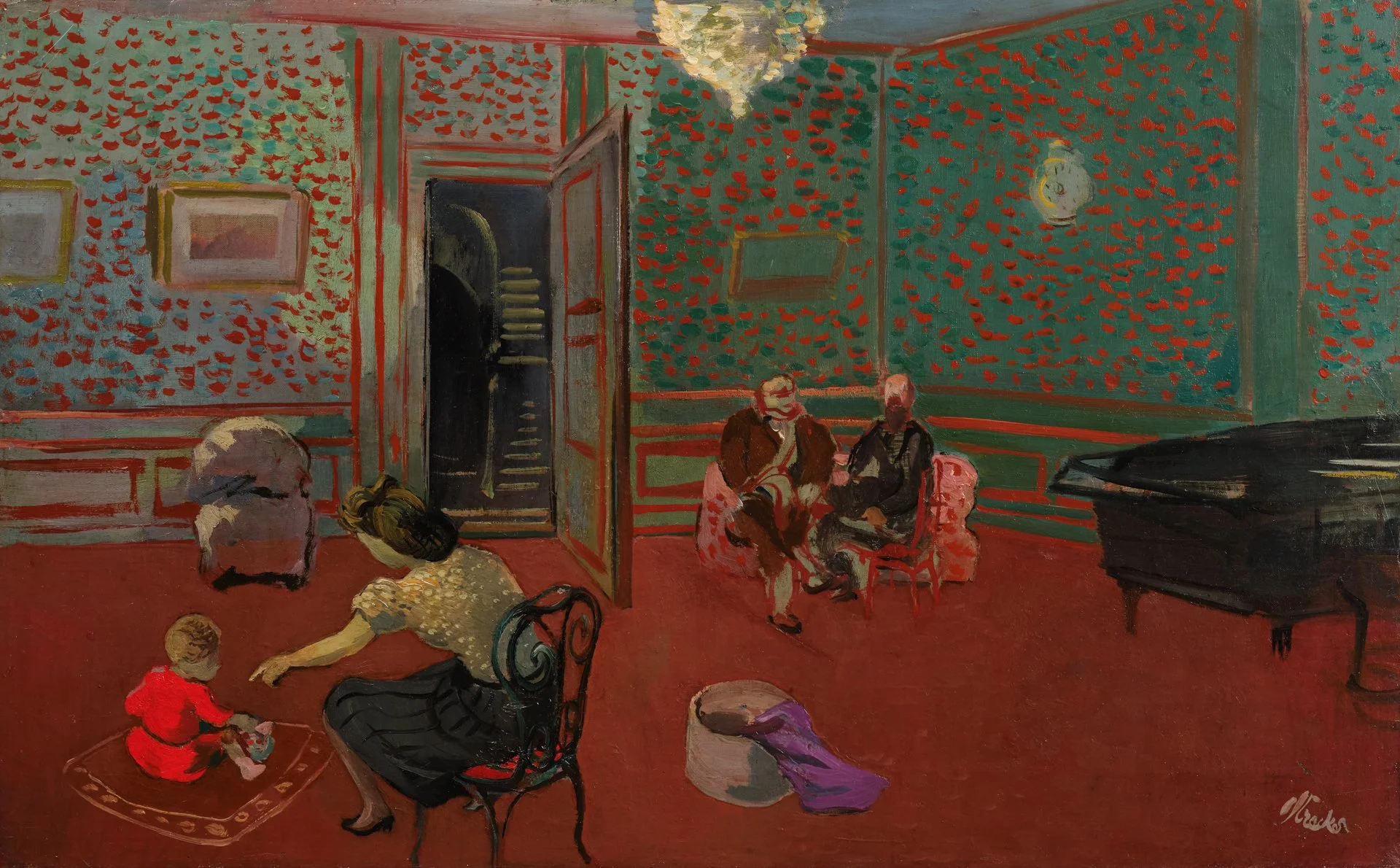
Paul STRECKER
(Mayence, Allemagne 1898 - Berlin, Allemagne 1950)
Intérieur, 1941
Huile sur toile
Signée en bas à droite
Datée nov 1941 au dos
38 x 61 cm
Provenance : Collection Wilhelm Strecker (étiquette au dos)
Né à Mayence en 1898, Paul Strecker se forme à Munich puis à Berlin avant de s’installer à Paris en 1924, où il demeure près de vingt ans. Il s’intègre rapidement à la vie artistique parisienne, fréquentant notamment Jean Cocteau, Christian Bérard, Pavel Tchelitchew, Jules Pascin et Pablo Picasso. Soutenu par le galeriste Alfred Flechtheim, il expose à Paris, Berlin et Düsseldorf, puis bénéficie d’une exposition personnelle à la galerie Jean Bonjean en 1933. Proche du courant néo-humaniste, Paul Strecker développe une peinture mystérieuse, où paysages, jardins et scènes d’intérieur sont souvent teintés d’une atmosphère énigmatique.
La peinture de Paul Strecker se distingue par ses compositions silencieuses, ses figures aux attitudes théâtrales et ses espaces baignés d’une lumière diffuse, qui confèrent au quotidien une dimension presque irréelle. En 1937, ses œuvres sont présentées à la galerie Julien Levy, à New York, et dix-sept de ses tableaux sont exposés au Petit Palais en 1939. Contraint de quitter la France pendant la Seconde Guerre Mondiale, il regagne Berlin en 1944, où il poursuit son activité de peintre, devient professeur à l’École des Beaux Arts et réalise de nombreux décors pour le théâtre et l’opéra. Mort prématurément en 1950, il laisse une œuvre fascinante, redécouverte notamment lors de l’exposition Paul Strecker – Magic of the Curtain au Kunsthaus Dahlem de Berlin en 2023-2024.
Born in Mainz in 1898, Paul Strecker trained in Munich and then in Berlin before settling in Paris in 1924, where he remained for nearly twenty years. He quickly became part of Parisian artistic life, associating in particular with Jean Cocteau, Christian Bérard, Pavel Tchelitchew, Jules Pascin and Pablo Picasso. Supported by the gallery owner Alfred Flechtheim, he exhibited in Paris, Berlin and Düsseldorf, before holding a solo exhibition at the Jean Bonjean Gallery in 1933. Closely associated with the neo-humanist movement, Paul Strecker developed a mysterious style of painting, in which landscapes, gardens and interior scenes are often imbued with an enigmatic atmosphere.
Paul Strecker’s paintings are characterised by their tranquil compositions, figures in theatrical poses and spaces bathed in diffused light, which lend everyday life an almost surreal quality. In 1937, his works were exhibited at the Julien Levy Gallery in New York, and seventeen of his paintings were shown at the Petit Palais in 1939. Forced to leave France during the Second World War, he returned to Berlin in 1944, where he continued to work as a painter, became a lecturer at the École des Beaux-Arts and created numerous sets for the theatre and opera. He died prematurely in 1950, leaving behind a fascinating body of work, which was rediscovered in particular during the exhibition Paul Strecker – Magic of the Curtain at the Kunsthaus Dahlem in Berlin in 2023–2024.