Pavel TCHELITCHEW
(Dubrovka, Empire Russe 1898 - Grottaferrata, Italie 1957)
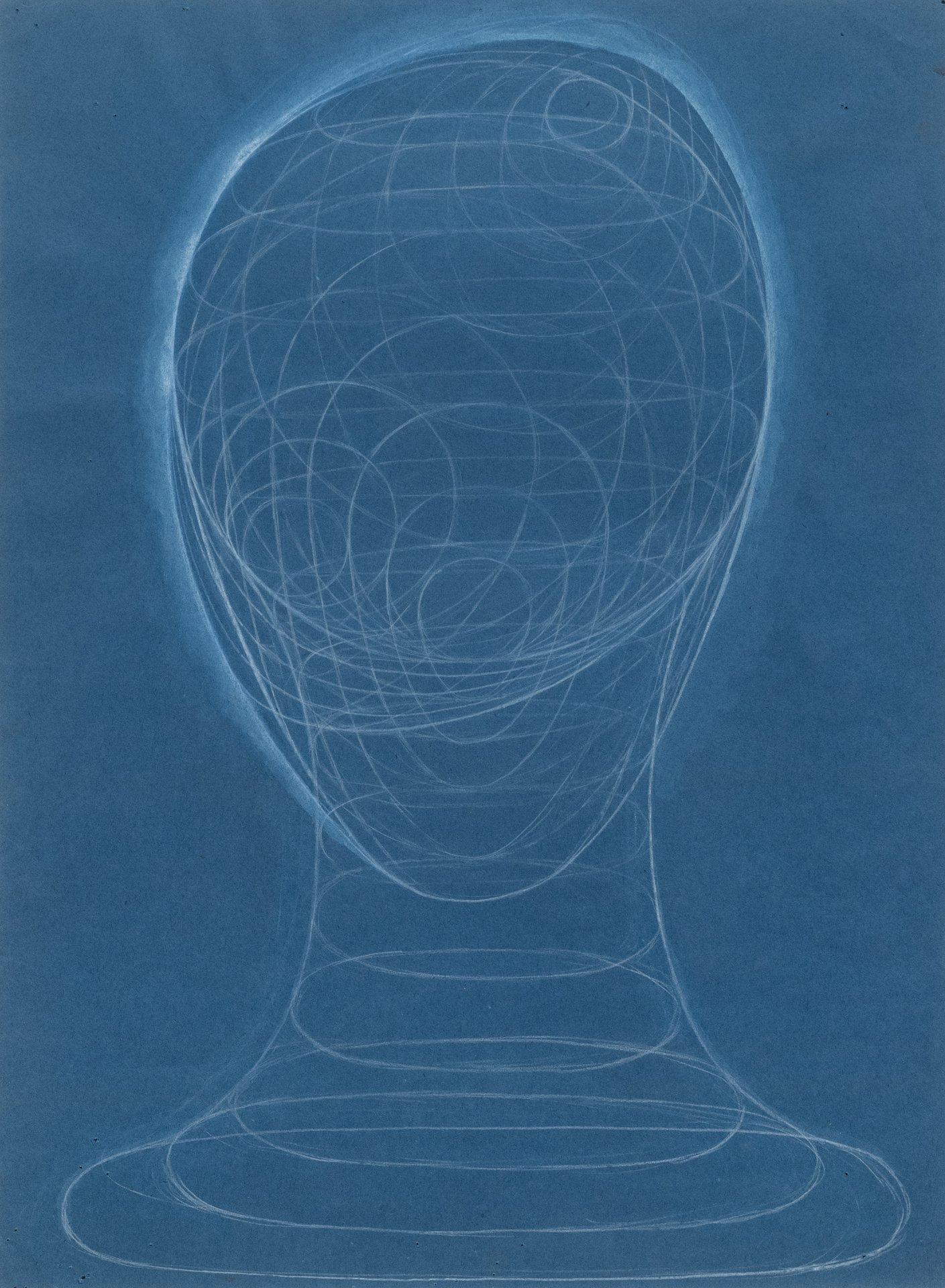
Tête
Crayon blanc sur papier bleu
60 x 43 cm
Né dans une famille aristocratique en Russie, Pavel Tchelitchev quitte son pays après la Révolution de 1917 et s’installe successivement à Kiev, Berlin, puis Paris, avant de partir pour les États-Unis. Dans le Paris des années 1920, il évolue au sein des avant-gardes artistiques et littéraires, tout en développant une voie très personnelle. Le néo-romantisme, auquel il est associé, se caractérise par un retour à l’émotion, au mystère et à l’imaginaire, en réaction au rationalisme et à l’abstraction pure. Ce mouvement privilégie les atmosphères poétiques, les visions intérieures, les thèmes du rêve, de la nature et de la métamorphose, souvent teintés de spiritualité. Chez Tchelitchev, cette sensibilité se manifeste par des compositions oniriques et une recherche sur la dimension invisible du monde.
Son œuvre se distingue notamment par son exploration du corps humain et des processus de transformation. Dans ses célèbres « têtes anatomiques », les visages se mêlent à des réseaux de nerfs et de structures organiques, suggérant une vision presque mystique de l’être. Cette approche illustre bien l’esprit néo-romantique : au-delà de la simple représentation, il cherche à révéler l’âme, l’énergie et les forces cachées qui animent la matière.
Born into an aristocratic family in Russia, Pavel Tchelitchev left his country after the 1917 Revolution and settled successively in Kiev, Berlin and then Paris, before moving to the United States. In 1920s Paris, he moved in artistic and literary avant-garde circles, whilst developing a highly personal style. Neo-Romanticism, with which he is associated, is characterised by a return to emotion, mystery and the imagination, in reaction to rationalism and pure abstraction. This movement favours poetic atmospheres, inner visions, and themes of dreams, nature and metamorphosis, often tinged with spirituality. In Tchelitchev’s work, this sensibility manifests itself through dreamlike compositions and an exploration of the invisible dimension of the world.
His work is notably distinguished by its exploration of the human body and processes of transformation. In his famous ‘anatomical heads’, faces intertwine with networks of nerves and organic structures, suggesting an almost mystical vision of the human being. This approach clearly illustrates the neo-Romantic spirit: going beyond mere representation, it seeks to reveal the soul, the energy and the hidden forces that animate matter.