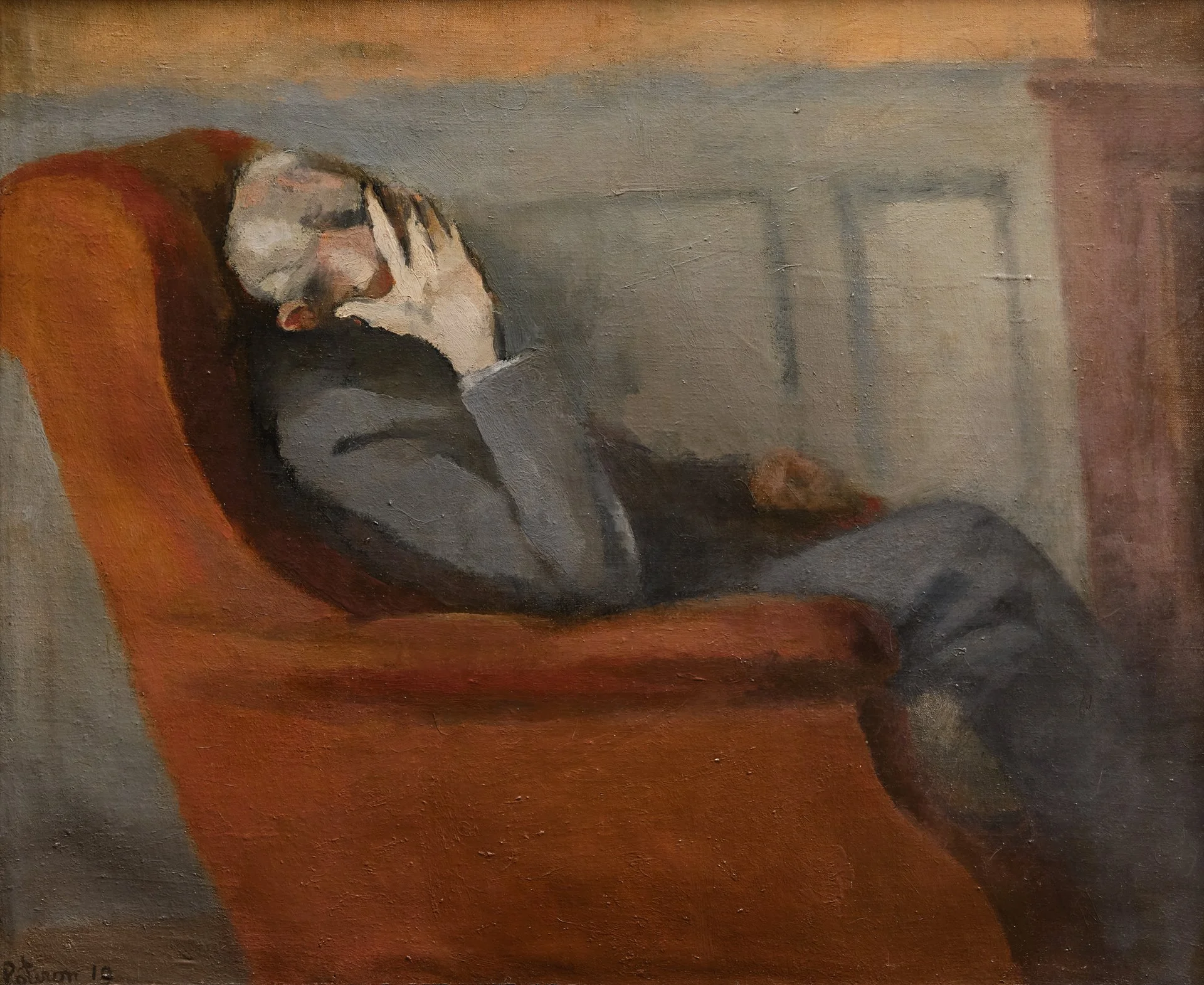
Robert LOTIRON
(Paris 1886 - Rueil Malmaison 1966)
Homme assis, 1919
Huile sur toile
Signée et datée en bas à gauche
60 x 74 cm
Robert Lotiron évolue dès les années 1900 au cœur de la jeune peinture française. Élève de Jules Lefebvre à l’Académie Julian, il y rencontre notamment Roger de La Fresnaye et Louis Marcoussis, tandis que son amitié avec Robert Delaunay, rencontré pendant son service militaire, l’introduit dans un cercle où il côtoie bientôt Guillaume Apollinaire, Albert Gleizes et Jean Metzinger. Après un passage à l’Académie Ranson auprès de Maurice Denis, l’artiste installe son atelier rue Bayen, où Henri Matisse vient lui rendre visite. Dès 1910, il expose au Salon d’Automne et au Salon des Indépendants, et participe en 1912, à Munich, à la deuxième exposition du Blaue Reiter aux côtés notamment de Picasso, Derain et Vlaminck.
Après la Première Guerre mondiale, Robert Lotiron s’inscrit dans une génération de peintres figuratifs qui cherchent une voie personnelle entre les avant-gardes et la tradition. Son œuvre associe alors la construction héritée de Cézanne, certaines réminiscences fauves et une forme de simplicité proche du Douanier Rousseau. Sa première exposition personnelle à la galerie Druet, en 1921, affirme sa place parmi les peintres importants de son temps. Suivront notamment des expositions à la galerie Jeanne Bucher en 1938 et à la galerie Carré en 1942. Différents musées se portant acquéreur de toiles. Après sa disparition, son œuvre est redécouverte à travers plusieurs rétrospectives, notamment à La Piscine de Roubaix en 2022 avec l’exposition Robert Lotiron, la poésie du quotidien.
From the 1900s onwards, Robert Lotiron was at the heart of the emerging French art scene. As a pupil of Jules Lefebvre at the Académie Julian, he met, amongst others, Roger de La Fresnaye and Louis Marcoussis, whilst his friendship with Robert Delaunay – whom he had met during his military service – introduced him to a circle where he soon found himself rubbing shoulders with Guillaume Apollinaire, Albert Gleizes and Jean Metzinger. After a spell at the Académie Ranson under Maurice Denis, the artist set up his studio on Rue Bayen, where Henri Matisse came to visit him. From 1910 onwards, he exhibited at the Salon d’Automne and the Salon des Indépendants, and in 1912 took part in the second Blaue Reiter exhibition in Munich alongside artists such as Picasso, Derain and Vlaminck.
After the First World War, Robert Lotiron became part of a generation of figurative painters seeking their own path between the avant-garde movements and tradition. His work thus combined the compositional approach inherited from Cézanne, certain Fauvist influences and a simplicity reminiscent of Le Douanier Rousseau. His first solo exhibition at the Galerie Druet in 1921 cemented his place amongst the leading painters of his time. This was followed, notably, by exhibitions at the Jeanne Bucher Gallery in 1938 and the Carré Gallery in 1942. Various museums acquired his paintings. Following his death, his work was rediscovered through several retrospectives, notably at La Piscine in Roubaix in 2022 with the exhibition Robert Lotiron, la poésie du quotidien.