Charles PEQUIN
(Nantes 1879 - Cugand 1963)
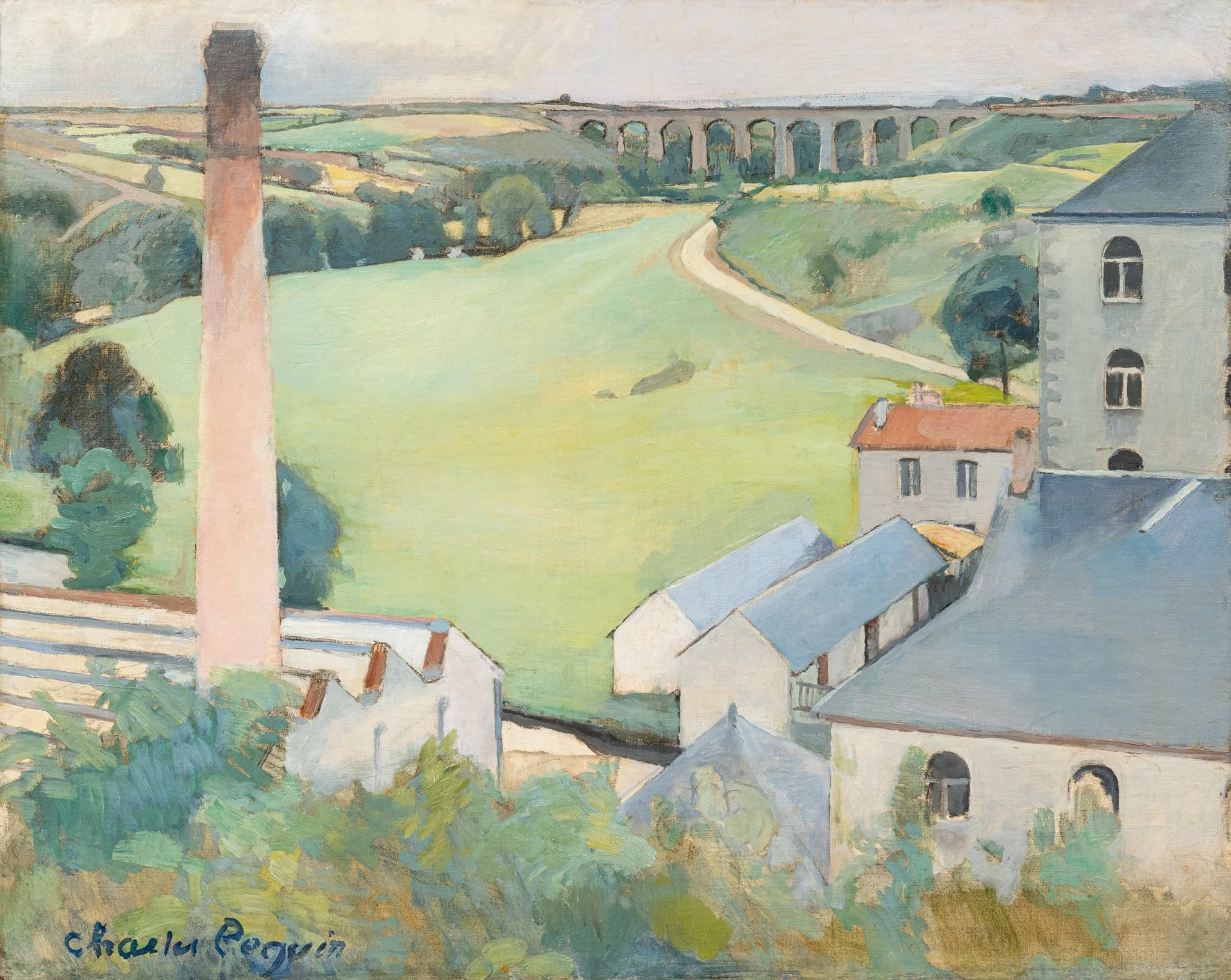
Hucheloup, 1910
Huile sur toile
Signée en bas à gauche
65 x 81 cm
Né à Nantes, Charles Pequin débute la peinture à l’âge de 13 ans. Il s’installe rapidement à Paris pour étudier aux Beaux-Arts, notamment dans l’atelier de Jean-Paul Laurens. Jeune et talentueux, l’artiste expose au salon des Artistes Français, puis au salon d’Automne et des Indépendants. Célébré de son temps, notamment par Elie Faure, Charles Pequin est un peintre de l’esprit des choses. A rebours de son temps, la peinture de Charles Pequin est une méditation du quotidien. L’artiste recherche la véracité du sujet, à la façon des peintres naturalistes.
Economie du trait au profit d’une délicate harmonie, l’artiste recherche l’équilibre du sujet contemplé. Il y a chez Charles Pequin ce supplément d’âme dans les représentations de sujets prosaïques. Ici, l’artiste livre une vision tendre d’Hucheloup au bord de la Sèvre Nantaise, ancienne usine textile fondée en 1830, par son aïeul Jean Péquin. Le site datant du début de l’ère industriel a été un catalyseur de modernité et de prospérité dans la région, aujourd’hui considéré comme un véritable vestige du patrimoine français.
Born in Nantes, Charles Pequin began painting at the age of 13. He soon moved to Paris to study at the École des Beaux-Arts, notably in Jean-Paul Laurens’ studio. Young and talented, the artist exhibited at the Salon des Artistes Français, then at the Salon d’Automne and the Salon des Indépendants. Celebrated in his own time, notably by Elie Faure, Charles Pequin was a painter who captured the essence of things. Ahead of his time, Charles Pequin’s painting is a meditation on everyday life. The artist sought the truth of the subject, in the manner of the naturalist painters.
With an economy of line in favour of a delicate harmony, the artist sought the balance of the subject under contemplation. In Charles Pequin’s work, there is that extra touch of soul in his depictions of prosaic subjects. Here, the artist offers a tender vision of Hucheloup on the banks of the Sèvre Nantaise, a former textile mill founded in 1830 by his grandfather Jean Péquin. The site, dating from the early industrial era, was a catalyst for modernity and prosperity in the region and is now regarded as a true relic of French heritage.
Bibliographie :
R. Allard, Les peintres français nouveaux, n°28, Charles Pequin, Editions de la Nouvelle Revue Française,
Gallimard, Paris, 1927, reproduit p. 23.