Denise Mannoni
(1918-2003)
Il y a des artistes que l’on redécouvre avec enchantement et Denise Mannoni en fait partie.
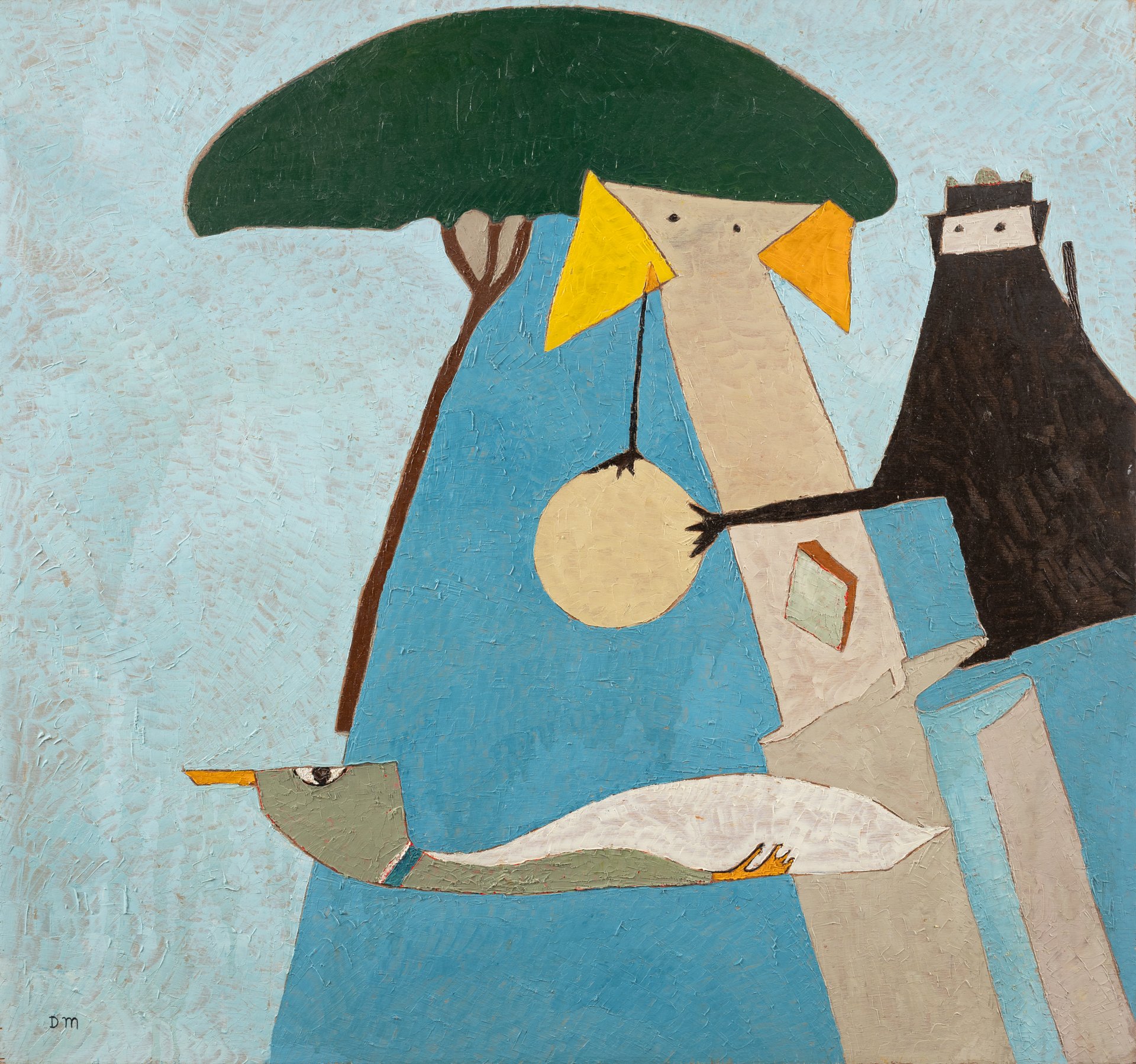
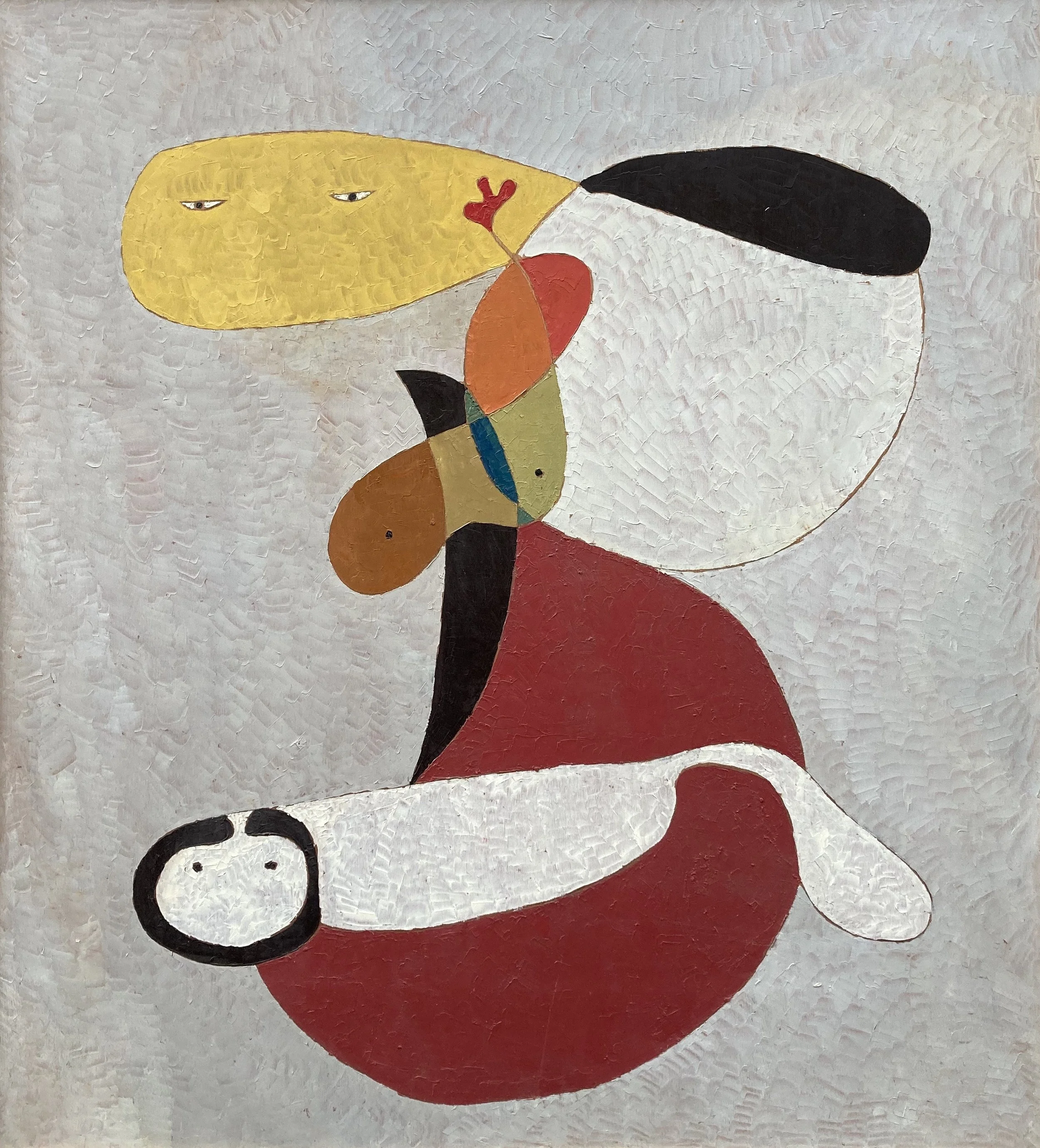
Artiste autodidacte, Denise Mannoni grandit à Madagascar et s’imprègne aussi bien de la nature luxuriante, de l’émerveillement exotique, que de la pensée libre d’un père professeur de philosophie, puis psychanalyste et ses précieux ouvrages sur l’art moderne. Dès 1938, elle met au point une technique de peinture au couteau et élabore ses premières compositions. Interrompue par l’effort de guerre, puis par les mouvements d’indépendance à Madagascar, Denise Mannoni rentre en France en 1948. Si le retour sur le continent est difficile, son mariage lui permet de retrouver une stabilité propice à la création. Le Paris artistique des années 1950 est bouillonnant, et l’artiste se familiarise avec les galeries, les musées, et les oeuvres de Brauner, Picasso et Klee. Elle s’initie à la céramique, et se joint à un groupe de jeunes artistes autour de Francine Delpierre.
En marge des courants de l’époque, l’artiste voit dans la peinture l’expression d’un monde secret peuplé de symboles au rayonnement onirique. On peut y apercevoir un dialogue intérieur, où les figures flottent dans un univers merveilleusement poétique. Si la peinture apparait jubilatoire et lumineuse, elle présente toujours une pointe de mélancolie. Peindre est en réalité un besoin vital de s’évader dans un imaginaire, loin de la froideur de la métropole. Sincère et étrangère à toute idée de séduction, Denise Mannoni nourrit sa mythologie d’une frénétique inventivité. L’artiste expose à partir de 1961 à la Galerie Git-le-Coeur (Pierre Weiler), et en 1964 à la Galerie Michel Boutin, et fait rapidement le choix de la fidélité en présentant ses oeuvres de manière quasi exclusive à la Galerie Valérie Schmidt de 1967 à 1997. On peut néanmoins note une exposition à Pittsburg, USA en 1969 et une exposition posthume chez John Adams Fine Art à Londres.
Expositions
GALERIE THIBAULT HÖLSCHER - 2024
Paris, France. Exposition personnelle.
« VIEWS & VISIONS » - 2017
Londres, Royaume-Uni. Exposition collective.
« PRIMARY SHAPES » - 2012
Londres, Royaume-Uni. Exposition personnelle.
GALERIE VALÉRIE SCHMIDT — EXPOSITIONS RÉGULIÈRES - 1967–1993
Paris, France. Expositions personnelles.
SALON DES TERRES LATINES - 1967–1972
Paris, France. Exposition collective.
GALERIE VALÉRIE SCHMIDT — PREMIÈRE EXPOSITION - 1967
Paris, France. Exposition personnelle.
MUSÉE D'ART MODERNE DE PARIS - Fin des années 1960
Paris, France. Exposition collective.
GIMBELS GALLERY - Fin des années 1960
Pittsburgh, États-Unis. Exposition personnelle.
GALERIE MICHEL BOUTIN - 1964
Paris, France. Exposition personnelle.
GALERIE PAUL WEILER - Années 1960
Paris, France. Exposition personnelle.
There are artists whom we rediscover with delight, and Denise Mannoni is one of them.
A self-taught artist, Denise Mannoni grew up in Madagascar, where she was immersed not only in the lush natural surroundings and exotic wonders but also in the free-thinking spirit of her father—a professor of philosophy who later became a psychoanalyst—and his valuable works on modern art. As early as 1938, she developed a painting technique using a palette knife and created her first compositions. Interrupted by the war effort and then by the independence movements in Madagascar, Denise Mannoni returned to France in 1948. Although her return to the continent was difficult, her marriage allowed her to regain the stability conducive to her creative work. The artistic scene in Paris during the 1950s was vibrant, and the artist became familiar with galleries, museums, and the works of Brauner, Picasso, and Klee. She began working with ceramics and joined a group of young artists centered around Francine Delpierre.
Standing apart from the trends of the time, the artist sees painting as an expression of a secret world populated by symbols with a dreamlike quality. One can sense an inner dialogue, where figures float in a wonderfully poetic universe. While the painting appears jubilant and luminous, it always carries a hint of melancholy. Painting is, in reality, a vital need to escape into an imaginary world, far from the coldness of the city. Sincere and untouched by any notion of seduction, Denise Mannoni nourishes her mythology with frenetic inventiveness. The artist began exhibiting in 1961 at the Galerie Git-le-Coeur (Pierre Weiler), and in 1964 at the Galerie Michel Boutin, and quickly chose to remain loyal by presenting her works almost exclusively at the Galerie Valérie Schmidt from 1967 to 1997. Notably, however, there was an exhibition in Pittsburgh, USA, in 1969, and a posthumous exhibition at John Adams Fine Art in London.