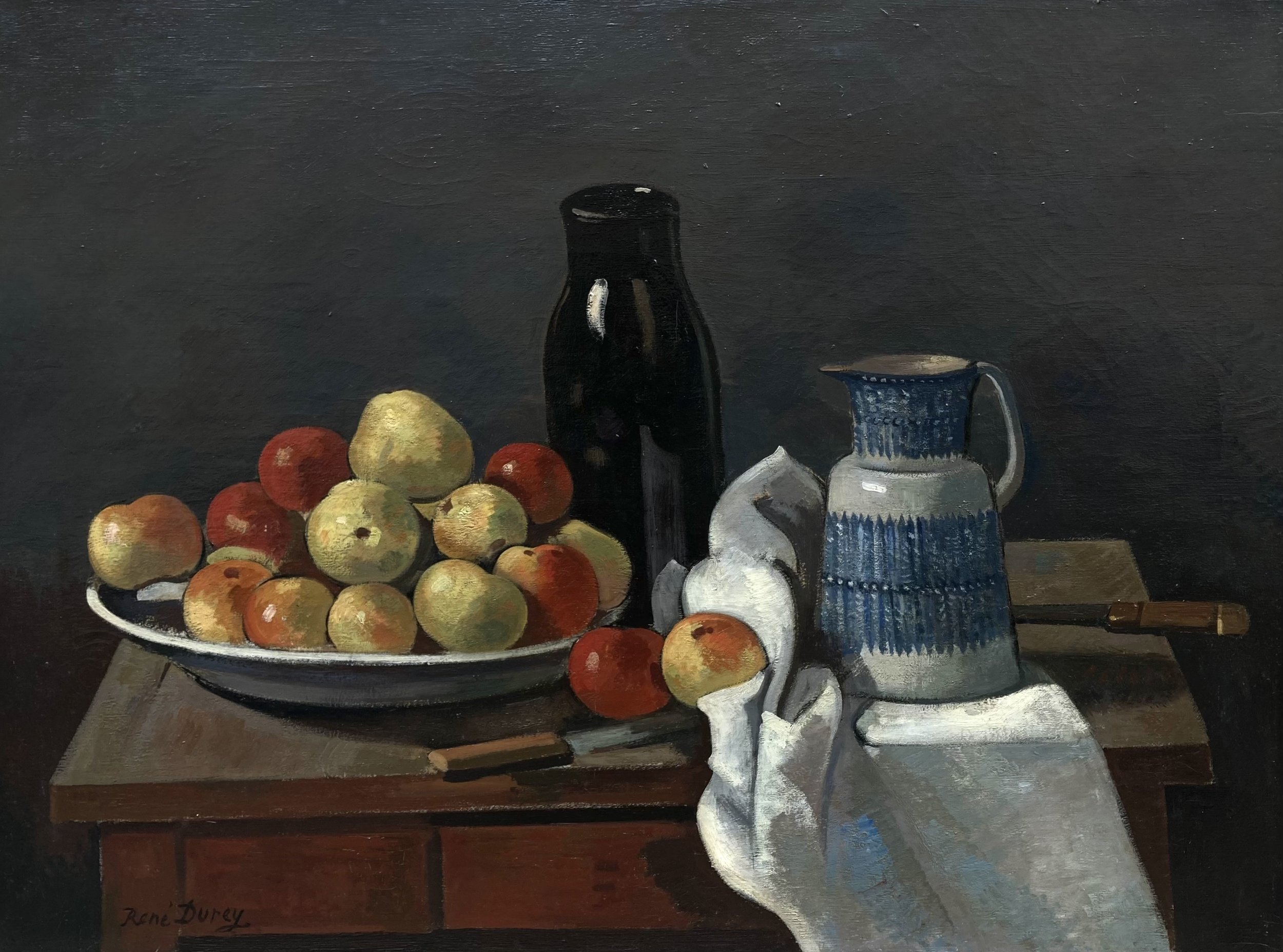
René DUREY (1890-1959)
Les Pommes
Huile sur toile,
Signée en bas à gauche
60 x 81 cm
Après s’être formé en autodidacte au contact de jeunes peintres de sa génération, René Durey visite l’Italie et expose pour la première fois en 1913 au salon d’Automne une vue de Volterra et un paysage de Naples où apparaissent déjà les caractères dominants de son oeuvre, discrète, sensible, et dont le réalisme s’accompagne d’une claire et objective poésie.
Malade puis convalescent à Saint Tropez en 1916, il noue d’amicales relations avec Signac et Dunoyer de Segonzac, puis à Paris avec Matisse et Vlaminck. S’il prend les conseils de chacun, il n’imite personne. Felix Fénéon qui dirige la galerie Berhneim Jeune, expose en 1919 une trentaine de ses dernières oeuvres : la grâce particulière des toiles de René Durey est reconnue par tous et désormais le peintre va suivre avec certitude sa voie personnelle, celle d’un monde d’une exigeante sensibilité.
Having taught himself through contact with young painters of his generation, René Durey visited Italy and exhibited for the first time in 1913 at the Salon d’Automne, presenting a view of Volterra and a landscape of Naples in which the defining characteristics of his work were already apparent: discreet, sensitive, and characterised by a realism accompanied by a clear and objective poetry.
While ill and then convalescing in Saint-Tropez in 1916, he formed friendships with Signac and Dunoyer de Segonzac, and later in Paris with Matisse and Vlaminck. Although he took advice from each of them, he imitated no one. Felix Fénéon, who ran the Berhneim Jeune gallery, exhibited some thirty of his latest works in 1919: the distinctive grace of René Durey’s paintings was recognised by all, and from then on the painter would confidently follow his own path, that of a world of demanding sensitivity.